
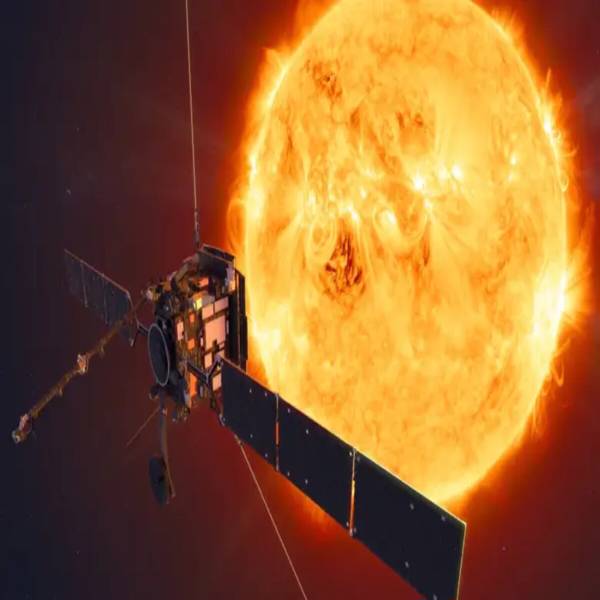
ISRO to Launch First Solar Mission Aditya-L1 today
The Indian Space Research Organisation (ISRO) is set to launch its Aditya-L1 mission to study the Sun on Saturday at 11:50 am from the second launch pad at Sriharikota.
The Aditya-L1 spacecraft is a 1,480 kg satellite that will be carried by India’s workhorse Polar Satellite Launch Vehicle (PSLV). The PSLV will first place the spacecraft in a highly elliptical orbit of 235 km x 19,500 km around the Earth. The orbit and velocity of the spacecraft will then be increased until it is slingshot towards the Sun.
The Aditya-L1 spacecraft will take about four months (125 days) to travel the 1.5 million km to the L1 point, which is a gravitationally stable point between the Earth and the Sun. The spacecraft will then be inserted into a halo orbit around the L1 point.
The Aditya-L1 mission will carry seven science experiments that will study the Sun’s atmosphere, magnetic field, and solar wind. The data collected by these experiments will help scientists to better understand the Sun and its impact on Earth.
The Aditya-L1 mission is a significant milestone for ISRO. It is the first Indian mission to study the Sun and it will help to advance our understanding of this important star.
The 23-hour 40-minute countdown to the launch of India’s Aditya-L1 mission to study the Sun began just after noon on Friday. The spacecraft will travel a distance of just 1% of the 150 million kilometers to the Sun. The space agency clarified that Aditya-L1 will not land on the Sun or approach it any closer, as it will be studying the Sun’s outer atmosphere from a safe distance.
The L1 point is located much further out than the Moon’s orbit, and no other planets cross its path. This means that the spacecraft’s view of the Sun will not be blocked by the Moon or any other planet, even when there is an eclipse on Earth.
Also read : Motorola Moto G84 5G: Available for purchase starting in September
In addition, studying the Sun from space eliminates the distortions that can occur when measurements are made from Earth’s atmosphere. The atmosphere can scatter light, distort images, and introduce other errors. By studying the Sun from space, scientists can get a more accurate picture of our star.
The Aditya-L1 mission to study the Sun was planned to be launched in the ideal window between January and September, considering the fuel requirements and planetary positions. This will allow the spacecraft to reach its designated orbit in early 2024, when the Sun will be in the ascending phase of its 11-year cycle. This will give scientists a good opportunity to study the Sun’s atmosphere and magnetic field during this active period.
The Aditya-L1 mission was initially planned to study the Sun’s corona from a low Earth orbit. It was later upgraded to an observatory-class mission that would study the Sun from the L1 point, a gravitationally stable point between the Earth and the Sun. The main objective of the mission is to understand the Sun and its effects on Earth. The advanced scientific experiments will also allow researchers to study the lower layers of the solar corona and hopefully find out why it is so ho